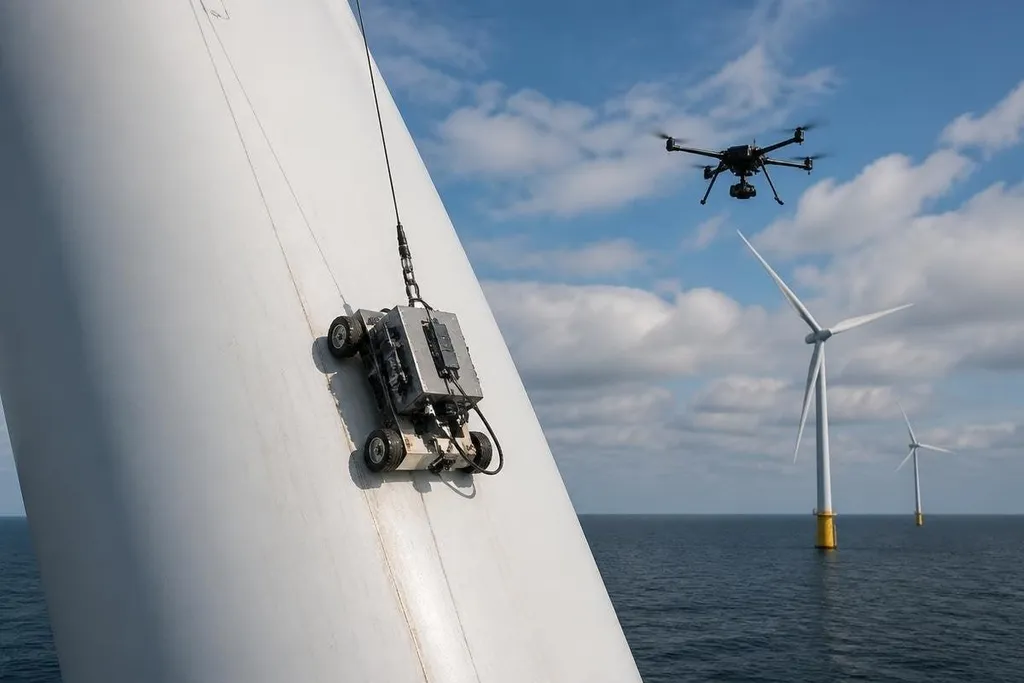
Wind turbines are difficult machines to inspect, repair, and clean because their blades sit high above the ground or far offshore. Useful advances in wind robotics will be measured by fewer rope-access hours, better inspection records, and repairs done before small faults become costly failures.
- Robots are moving from inspection toward repair.
- Offshore systems need better docking and control in rough weather.
- The proof will come from repeatable work, not a short demo.
Robots that inspect blades without rope crews
Blade inspection is the clearest place for robotics to earn its keep. A climbing robot can move along the blade surface while cameras record cracks, erosion, lightning damage, and worn coatings.
The hard part is keeping contact with a blade that curves, twists, and moves in wind. A robot needs wheels, magnets, suction, or another grip method that works across painted and damaged surfaces. Its camera also needs a steady view, because a blurry image can turn a repair decision into a return visit.
The useful change will be a complete record for each blade.
That means the same surface is checked on later visits, with damage located against a known position rather than described in loose notes. A maintenance team can then compare new images with older ones and decide which fault needs a crew first.
Drones that work around the turbine
Drones already collect images around towers, blades, and nacelles. More controlled flight near the structure is the next target, where wind changes around the tower and long blades can block a drone's view.
A useful system would plan a safe path, hold a steady distance from the blade, and return to a landing point when its battery runs low. That requires cameras, position sensors, and software that can keep the aircraft away from moving parts.
Offshore work adds another problem. A drone may need to launch from a vessel, inspect a turbine, and return while the deck moves beneath it. A docking station on the vessel or turbine could reduce the need for a person to catch or recover the aircraft, but the full process still needs proof in changing weather.
A cracked blade still needs a repair plan after an inspection drone finds it. Reports at Robot24 can connect that finding to the robot, turbine, test date, and repair method before the article turns to machines that fix damage.
Robots that repair instead of report
Inspection finds damage. Repair work determines whether the robot saves a visit.
Several tasks suit robotic tools: applying a coating to a worn blade edge, sealing a small surface fault, cleaning salt from equipment, or carrying tools across a tower platform. Each job needs steady force and a clear way to check the result.
Repair is harder than inspection because the robot must control an end effector, the tool at the end of its arm, against a surface that may move. It also needs a safe stop when the tool meets an unexpected shape or loses contact.
The first systems may remain supervised by a technician. That still has value if one person can watch work from the vessel or control room instead of climbing each turbine. Full autonomy can come later, after companies have enough repair records to test the system against known faults.
Subsea robots for cables and foundations
Offshore turbines depend on equipment below the waterline. Remotely operated vehicles can inspect export cables, anchors, foundations, and scour around the base of a turbine. Scour is soil washed away by moving water, and it can weaken support around a foundation.
Better repeat inspection is the useful step. A subsea robot needs to return to the same route, record the same points, and work with limited visibility. Sonar can help when cameras cannot see through dark or cloudy water, but the data still needs a person who can judge whether a change needs repair.
That data link matters. A robotic inspection only helps a maintenance team if the result reaches the people who plan vessels, parts, and crew time. A file of images without a clear fault location leaves much of the work unfinished.
A buying checklist for wind operators
Before backing a wind robotics project, check these points:
- Task first: name the exact job, such as blade inspection or cable survey.
- Surface contact: confirm how the robot stays attached to the turbine or moves through water.
- Weather limits: record the wind, rain, wave, and visibility limits for each operation.
- Human control: state when a technician must guide, stop, or recover the robot.
- Proof of work: require a report that places each fault on the turbine and supports later comparison.
I'd watch repair systems more closely than another image-only inspection drone. A clear fault report matters, but a robot that can complete a small repair may cut the vessel visit that follows.
The practical test is whether one system can inspect, return safely, and leave a repair record that a maintenance crew can act on.